
10 Laser sources
Fibre laser source repair
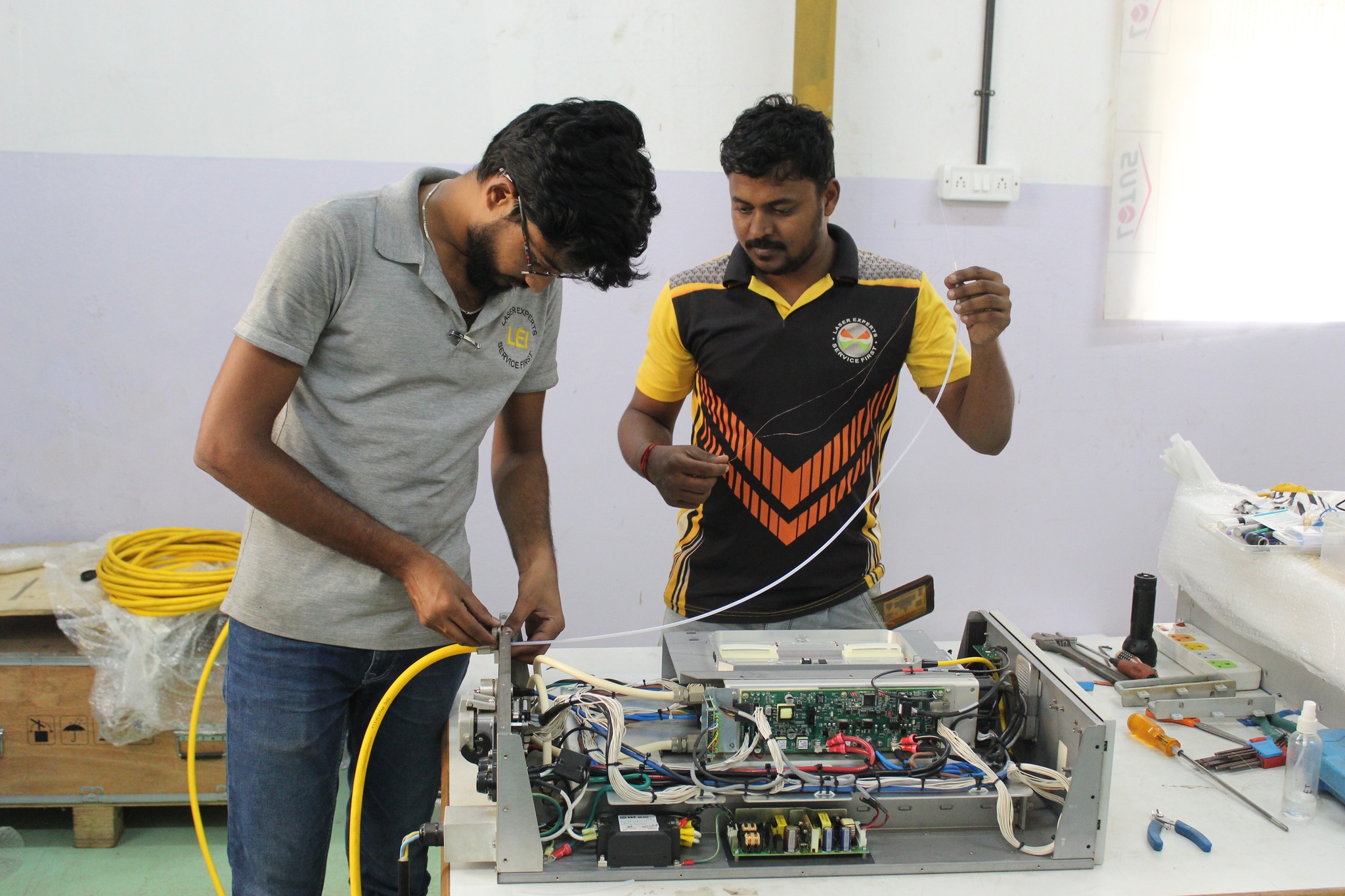
Power loss, alarms or complete failure: we isolate the fault down to module level, repair precisely and test the source under load before it goes back.
Typical faults
- Output power drops gradually or fluctuates during cutting
- Source alarms, e.g. temperature, back-reflection or supply faults
- Failure of individual pump modules or driver electronics
- Damaged fibre connector (e.g. QBH) from contamination or back-reflection
- Damage from condensation due to unsuitable cooling water temperature
Our approach
- Pre-assessment – from rating plate, alarm history and fault description.
- Incoming inspection – visual check, power and supply measurement, reading fault memories.
- Fault isolation – testing pump diodes, drivers, power supplies and beam path down to module level.
- Findings & quote – repair or replacement, with costs, before we continue.
- Repair & test – repair, power and stability test, test report.
Sources we work on
- IPG
- Fibre cables and diode modules – IPG repair in detail
- MAX
- Diodes, combiners, optics, modules (documented repair of a 20 kW source)
- Raycus
- Combiners, pump diodes, pilot laser (documented repair of a 6 kW source)
- JPT, GW
- Fibre laser sources
Laser Experts is not an authorised service partner of the manufacturers named. A third-party repair may affect an existing manufacturer warranty – please check this in advance.
Prevent rather than repair
Many failures originate outside the source: wrong cooling water temperature, dirty protective windows or back-reflection when cutting highly reflective metals. As part of maintenance we check these points regularly.
Related services
-
04
Cutting head repair
Restoring optics, sensors and focusing unit.
-
07
Laser chiller service
Fix temperature alarms before they damage the source.
-
03
Fibre laser power upgrade
Instead of repair: install a higher power class.